Design is an Investment, Not a Cost: How to Calculate Your Brand’s ROI

When a business owner looks at the monthly balance sheet, it is common to see clear categories: rent, salaries, and logistics. And somewhere in the middle of expenses, there is a line for “Design and Marketing.” For many managers, this is still viewed as a “necessary evil” or simply an aesthetic cost to make things look pretty.
But what if I told you that viewing design as a cost is actually holding your company back from growing?
Big brands like Apple, Nike, or Nescafé don’t invest millions in design just for vanity. They know a secret that many small and medium-sized businesses ignore: Design is not decoration. Design is problem-solving and business strategy.
In this article, we will demystify the concept of “pretty drawings” and demonstrate how a professional investment in design yields a real, measurable, and profitable Return on Investment (ROI).
The Difference Between Cost and Investment
Before we talk numbers, it is crucial to adjust the mindset.
- A Cost is an expense that brings no direct return. It is money that goes out to keep the lights on. Once spent, it is gone.
- An Investment is the allocation of resources with the expectation of generating a future benefit greater than the amount applied.
When you hire a professional graphic designer, you aren’t paying for “doodles” or “colors.” You are buying Brand Equity. Good design works for you 24 hours a day: your website sells while you sleep, your packaging communicates on the shelf without salespeople around, and your logo creates a memory in the consumer’s mind.
The 3 Pillars of Financial Return on Design
How does design translate, practically, into more money in the company account? Through three fundamental pillars:
1. Immediate Trust
Studies indicate that users take only 0.05 seconds to form an opinion about your website. If the visual is amateur, dated, or confusing, your company’s credibility crumbles instantly. Professional design eliminates initial friction and tells the client: “This company is serious, secure, and high-quality.”
2. Perception of Value (The Power of Premium Pricing)
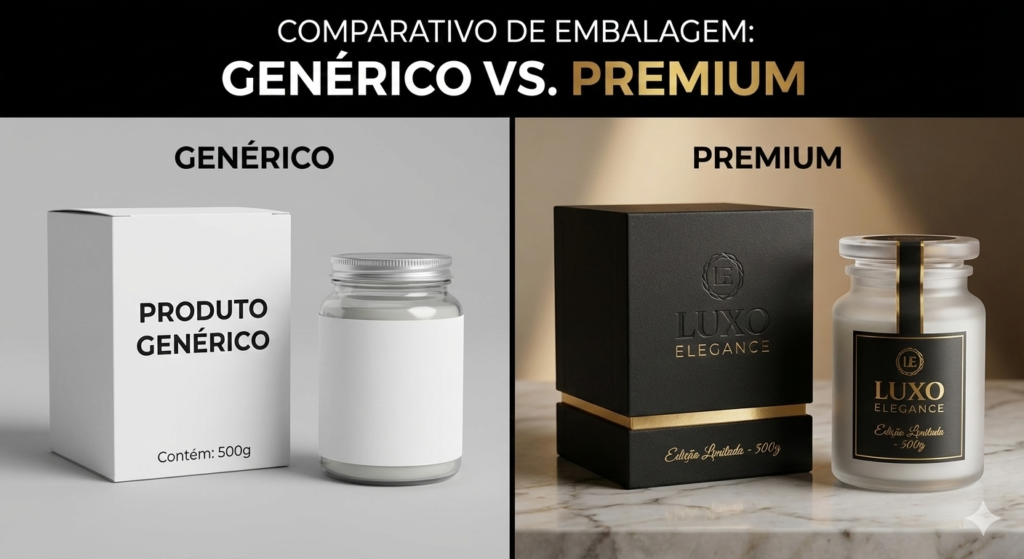
Why does a consumer pay $1 for a coffee at a gas station and $4 for the same coffee at a shop with sophisticated branding? The answer is Perceived Value.
Quality design allows you to position your product at a higher tier. A premium visual identity justifies higher prices, increasing your profit margin without necessarily changing the product itself.
3. Differentiation in a Saturated Market
In a world where everyone sells the same thing, whoever stands out wins. Design is the fastest tool for differentiation. If your company looks visually similar to every other one in your niche, the only way to compete is by lowering your price (which destroys profit). Design allows you to compete on value, not price.
The Formula: How to Calculate Design ROI
Calculating the ROI (Return on Investment) of something intangible like “brand” might seem difficult, but it is possible if we look at the right metrics before and after a design project.
The basic formula is:
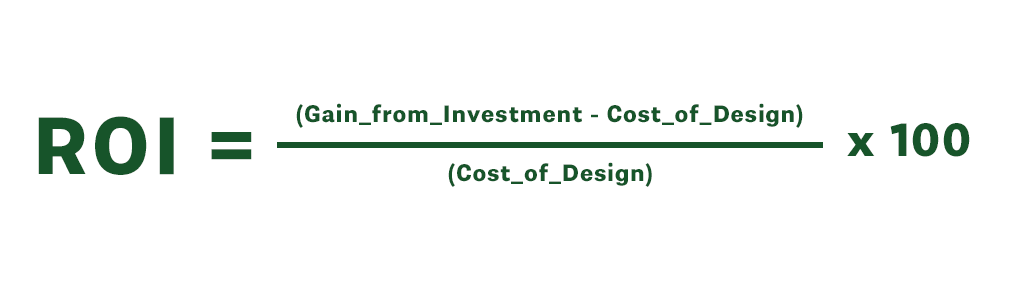
What should you measure to find the “Gain from Investment”?
- Conversion Rate: After redesigning the website or landing page, did the percentage of visitors asking for a quote increase?
- Direct Sales: After changing the packaging, by what percentage did sales of that product rise in the following quarter?
- Sales Cycle Time: With professional sales presentations and brochures, can your sales team close deals faster?
If you invested $2,000 in a rebranding and, in the following six months, the new image helped generate an extra $10,000 in sales that you wouldn’t have made with the old image, your return is massive.
The Hidden Cost of “Cheap Design”
There is a famous quote by Ralf Speth (former CEO of Jaguar Land Rover):
“If you think good design is expensive, you should look at the cost of bad design.”
Opting for amateur solutions (doing it in Canva without knowledge, hiring the “nephew who knows Photoshop,” or using generic $5 logos) brings devastating hidden costs:
- Rework: You will eventually have to pay a professional to redo everything a year later, spending double.
- Printing Errors: Poorly configured files result in thousands of flyers being sent to the trash.
- Invisibility: Your brand blends into the background noise and is ignored.
Investing in professional graphic design isn’t about aesthetics; it’s about smart economics. It is the difference between having a business that survives and a brand that thrives.
Every dollar (or euro) invested in your company’s image should come back to your pocket in the form of recognition, trust, and sales. If your current image isn’t doing that for you, then it is time to change.
Are you ready to elevate your brand?
Don’t leave money on the table because of a visual presentation that doesn’t reflect the quality of your work.
I help companies turn their image into powerful sales tools. Contact me here and let’s talk about how design can leverage your results this year.